Last year, out of 40,000 applications,
Y Combinator funded just 450 startups.
This translates to an acceptance rate of just 2%, making Y Combinator one of the most selective and competitive startup incubators in the world.
Out of tens of thousands of applicants each year, only a tiny fraction make it through, often after multiple rounds of rigorous evaluation. For founders, being accepted is not just a badge of prestige—it provides access to unparalleled mentorship, funding, and a network that can dramatically accelerate a startup’s growth. The low acceptance rate underscores the reality that even promising ideas face stiff competition in the pursuit of YC’s backing.
Round 1
Can you guess if the startup was funded by YC?

Oxygen
Oxygen is a fintech company, offering business banking focused on businesses. Currently, oxygen is on the verge of shutting down.
Yes funded
No funding

GoCardLess
GoCardless is a fintech company building a global bank payment network enabling direct payments for businesses.
Yes funded
No funding
YC's portfolio
Every YC winner has a crowd of copycats
YC has backed billion-dollar giants like DoorDash, Stripe, and Airbnb. Yet a closer look at their 2005–2024 database shows dozens of similar startups chasing the same ideas—most are still striving, have been acquired quietly, or didn’t make it.
Lorem Ipsum has been the industry's standard dummy text ever since the 1500s, when an unknown printer took a galley of type and scrambled it to make a type specimen book. It has survived not only five centuries, but also the leap into electronic typesetting, remaining essentially unchanged. It was popularised in the 1960s with the release of Letraset sheets containing Lorem Ipsum passages, and more recently with desktop publishing software like Aldus PageMaker including versions of Lorem Ipsum.
The strategy
So, what is the secret?
Now we know that Y Combinator funds multiple startups with nearly identical ideas. It seems wasteful. Confusing. At first glance, it seems like a mistake—or at least inefficient. But what if there's business to it.
To understand this, let's look at 5 companies Y Combinator invested in the ‘payment gateway’ space.
What looks like redundancy is actually the only rational strategy in a hits-driven business. YC knows that most investments will fail or return modest multiples. They're not trying to avoid failure—they're trying to ensure they're in the room when exponential success happens.
You don't need five wins. You need one Stripe, one Airbnb, one DoorDash. That single outlier will generate returns that make every loss, every write-off, every failed bet completely irrelevant.
That's why YC bets on similar ideas, back competing startups, and invest in spaces that look crowded. They're not hoping lightning strikes. They're buying enough lottery tickets to guarantee they're holding the winning number.





Paystack
Wave
Stripe
Magic
Bridgecard
-$125,000
-$125,000
+$50,000
+$30,000
-$125,000
-$125,000
YC’s investment
in total
~ $476 million

YC’s invests
$125,000 each
in 5 companies

Stripe becomes a unicorn. YC's $625K initial investment is now worth $476 million!
what is a unicorn?
Magic closed after failing to achieve PMF. YC writes down its $125K seed check to zero.
what is PMF?
Regulatory pressure forced Bridgecard to shut down, and YC’s $125K vanished when runway ended.
what is a runway?
YC invested $125,000 in each company for 7% equity. That's 5 bets on similar ideas.
what is equity?
Paystack gets acquired by another company but YC recovers about $50,000 from this acquisition.
what is acquisition?
Wave gets acquired too but YC recovers even lesser +$30,000 from this acquisition.
what is acquisition?
Y Combinator 726x-ed their return on investment!
what is roi?
CEO says
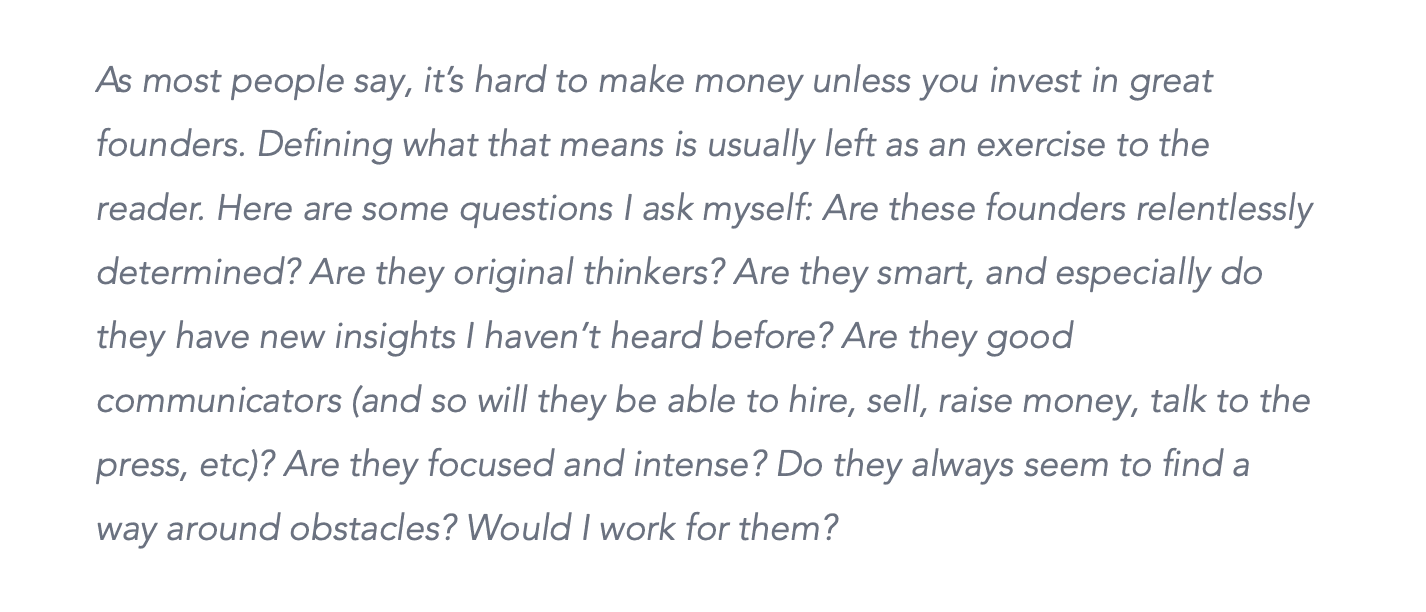
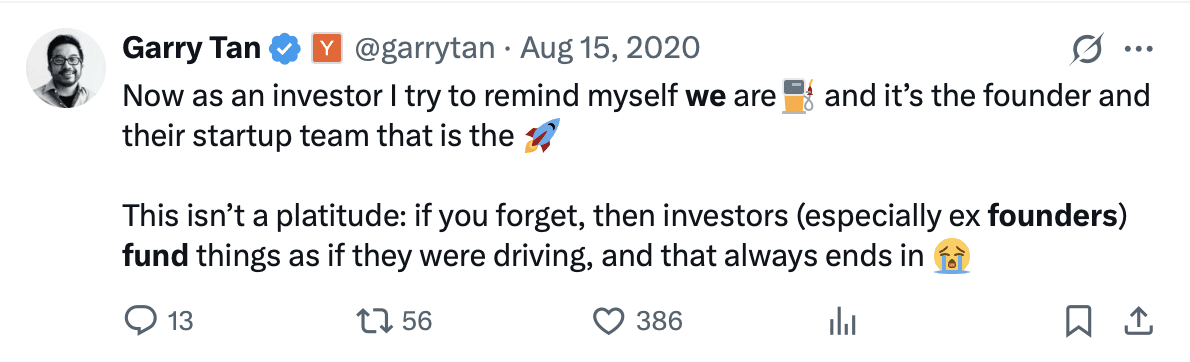
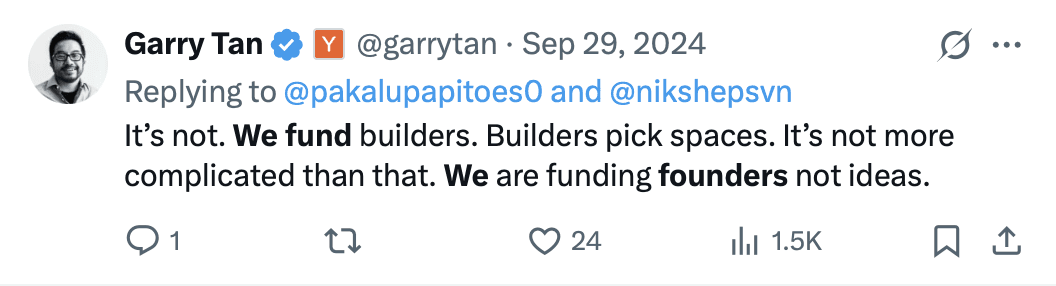
Investing in founders rather than companies
Tan points out that the best founders don’t treat their startup as a fixed concept but as a constant experiment. YC’s job, therefore, isn’t to predict which idea will work — it’s to back the people who will find the idea that works. That’s why YC’s track record isn’t defined by perfect ideas, but by resilient, adaptable founders who turn iterations into success stories.


Inside the founder's mindset
Who are these founders?
Let’s look at interviews from top YC founders to see what stands out and what that reveals about Y Combinator’s standards for acceptance.
Lorem Ipsum has been the industry's standard dummy text ever since the 1500s, when an unknown printer took a galley of type and scrambled it to make a type specimen book. It has survived not only five centuries, but also the leap into electronic typesetting, remaining essentially unchanged. It was popularised in the 1960s with the release of Letraset sheets containing Lorem Ipsum passages, and more recently with desktop publishing software like Aldus PageMaker including versions of Lorem Ipsum.












founder mode
certainly get a co-founder
stressful times
product so good people tell friends
FAANG trap
conflict avoidance
sensible business model
talking to customers early
make something people want
strong culture
we’ll figure it out
conflict avoidance
enterprise sales
government relations
network effects
nearly went out of business
first version doesn't work
international expansion
100 customers who love you
frugality, focus, obsession and love
team first
optimists
technical founders
customer obsessed
hiring is culture
game recognized game
seek truth
infinite learner
write it down
plan at the start
one yes vs one no
action bias
loss aversion
product-market fit
long-term vision
skill match vs trust
losing control
have to unlearn
loneliness of founder
organic growth
data informed
what do you want to build?
build character
pruning the tree
build in public
intuitive
fire and hire
shotgun wedding
Leadership
design partners
lean vs fat startups
cockroaches
Challenges
Strategy
Growth
action bias
drop-out
pivot
awkward conversation
lifestyle inflation
yanking out requirements
Data deep dive
Mapping founder backgrounds
A significant proportion of YC founders hail from computer science and engineering (CSE) backgrounds, frequently emerging from prestigious institutions such as Stanford, MIT, and other leading universities. Many of them also bring experience from major technology firms, having honed their skills at companies like Google, Facebook, or Microsoft before embarking on their entrepreneurial journeys.
gender
- 81.65%
- 18.35%
schools
- 22.62%
- 17.98%
- 14.46%
field
- 59.59%
- 9.35%
- 8.18%
work
- 36.37%
- 34.59%
- 15.48%
The Conclusion
Who should 'you' become?
The more we think about it, the more it feels like an invitation to look beneath the surface. It makes us wonder who these founders truly are, what environments they were shaped by, and what events in their lives guided them toward this path. It also raises the broader question of how someone can grow into that kind of founder.
All of this will be explored in part two, so stay tuned.
Credits
Info design by Rakshit Keswani Keswani and Madhurima Chatterjee
Website created by Rakshit Keswani Keswani and Madhurima Chatterjee
Written by Rakshit Keswani Keswani and Madhurima Chatterjee
Project advised by Karen Cheng
Rakshit Keswani Keswani and Madhurima Chatterjee are Human-Computer Interaction + Design students at the University of Washington, Seattle.
Data sources
Y Combinator companies 2005-2024 from kaggle.com
Y Combinator data based from ycombinator.com
Videos from YouTube.com